Nicole schreibt...
Zealand 2020 |
 |
 Can we reboot 2020? This edition has a virus.
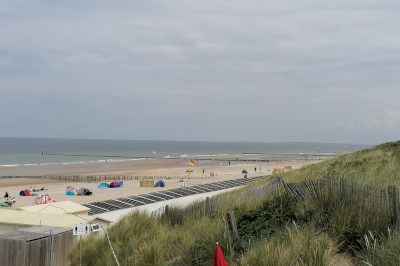
This year will certainly go down in history as the one in which countless travel plans got pulverized (among many many other things). So with everything cancelled left and right all over spring and airplane travel in particular looking shaky, it was time to resurrect an old travel idea: Returning to Domburg on the Dutch coast, where I spent one of the worst weekends of my life on a godawful camping trip in godawful company. After two sleepless nights in a wind-blown tent, I had decided to call it quits and we had gone home earlier than planned. Not really Domburg's fault though and the mother had also wanted to return there to exorcise her own demons of a trip gone awry many years ago in her youth. So now seemed to be a good time to do so and we booked a lovely hotel close to the beach (which seemed to be making up for lost months and the hope of countless people not going to the Mediterranean by charging eye-watering prices).
As it turned out, at least the Netherlands as such were a destination well-chosen with little Corona fuss in evidence. The hotel had arranged a "one-way-system" around the place and breakfast would be served in the rooms rather than the big breakfast room, but at least no masks were mandatory in shops, restaurants and other places, which made it mostly possible to forget the virus and all its drama existed.
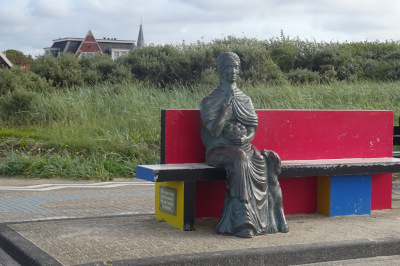 So here we were, arriving just around noon for a first walk through the village and along the dunes, where the Germanic Goddess Nehalennia has been looking out across the sea towards England for a long time. While she isn't all that well-known, a temple of hers from Roman times has been found near Domburg and statues of her scattered all over Zealand. Domburg really isn't much more than a main street lined with restaurants and shops, surrounded by a few neat little streets and hotels and further by countless camping sites where Germans and Dutch cluster in droves in anything from small camping tents to RVs the size of a freight truck. The exploratory walk was cut even shorter by the realization that the weather was surprisingly nice, so we quickly returned to the hotel to grab beach stuff and park ourselves on the endless lovely beach for the rest of the afternoon - including a dip in the bracingly cold North Sea.
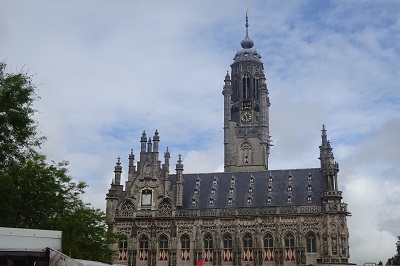
Middle-European summer being what it is, we had to plan for alternatives to the beach anyway and of course I do want to see something of the area, when I travel. With the forecast being lousy for Thursday, we decided to go to Middelburg, the capital of Zealand. Centuries ago, when the whole of Zealand was indeed "a land in the middle of the sea", consisting of several islands in the delta of the Rhine and Schelde rivers, Middelburg was actually the second-most important town of the Dutch Golden Age (after Amsterdam) where hundreds of ships for the mighty VOC (The Dutch East India Company) were built and early scientists developed the first microscopes and telescopes.
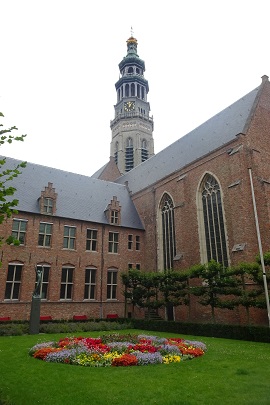
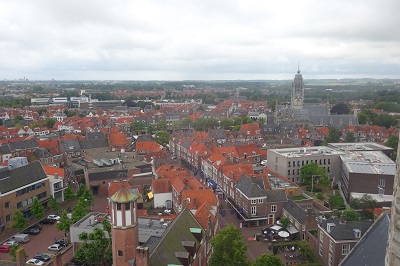
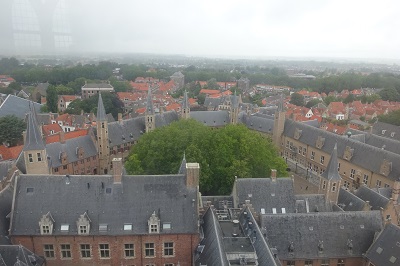
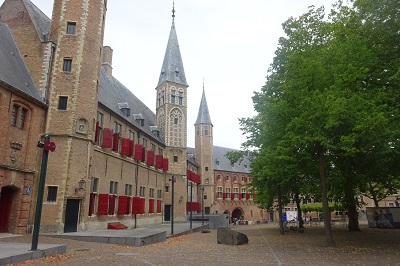
The town is still surrounded by a perfect moat and acquired some impressive buildings includign a massive abbey, which spouts the "Lange Jan", the tower of the Nieuwe Kerk, which we could trudge up over 266 steps. The weather was as awful initially as predicted, so the view wasn't all that great, but here are two pictures across the small city and into the inner courtyard of the Abbey, which is now partly used by the provincial government and partly houses the Zeeuws Museum, which would be our next destination:
|
 |
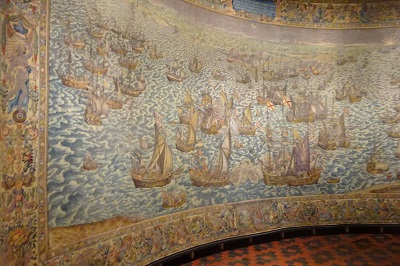
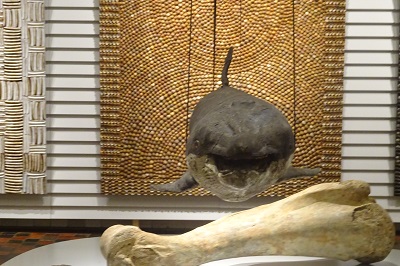
 To avoid congestion during Corona times, they sold a strictly limited number of tickets online only for a certain time slot and had also arranged a one-way-system through the museum. I can only assume they also closed off some areas as I found the whole thing a little bit underwhelming with a mix of history (as evidenced by these massive tapestries depicting some ancient sea battles of the Dutch navy against... I wanna say, Spain, but honestly I've forgotten and it's hard to keep track of who went to war with who when in those days) and some rather oddball art as this stuffed shark hanging in front of large "carpets" made entirely of hundreds of seashells. I definitely learned less about Zealand than I had anticipated and was out of the museum again within half an hour.
|
 |
|
 |
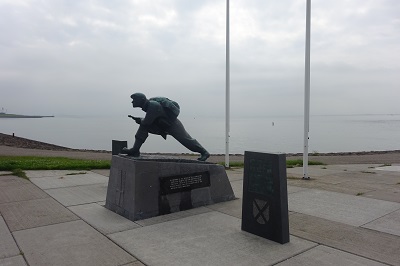
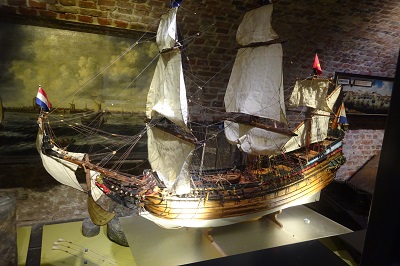 Next morning we went on a second outing, this time to Vlissingen, to English readers perhaps better known as Flushing (and indeed the place that lent its name to the New York City area of the same name). Long after Middelburg had lost its status of importance, Vlissingen rose to become a major port at the mouth of the Schelde river and these days it has a really rather good maritime museum called MuZEEum, which was our first port of call and this one really worth it, depicting the maritime history of the area from the grand old ships of the VOC via fishing boats to today's cargo ships. It also revealed the (to me) new fact that Walcheren (the island on which Domburg, Middelburg and Vlissingen are located) had not been flooded during the great disastrous flood of 1953, but some years before in late 1944 when the Western Allies consciously targeted the dykes. Vlissingen itself was stormed by landing troops to chase the nazis out and secure the all-important mouth of the Schelde and a port to land more troops. So here's also a rather sober monument to what was then "Uncle Beach" and a look across the waterfront:
|
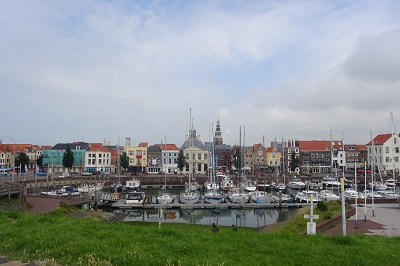 |
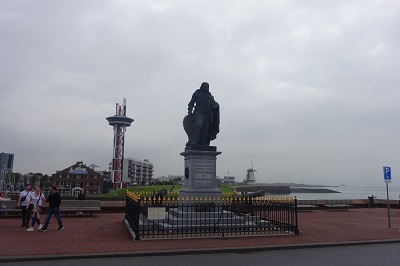 Vlissingen's other claim to fame is being the birthplace of Michiel de Ruyter, who worked his way from humble sailor to most celebrated Admiral of the Dutch navy, involved in several sea battles in 17th century. He secured eternal fame by defeating the English navy in 1666 and sailed up the Medway to Chatham, where he destroyed the English fleet apart from the flagship Royal Charles, which he nicked from under English noses to take home to Amsterdam. Anyway, good old Admiral de Ruyter is now looming large over the entrance to the marina of Vlissingen and the old fort (which was supposed to be tourable as part of the MuZEEum but closed when we got there). After a break in a nearby cafe it was time to return to Domburg and actually spend another few nice hours on the beach and risk another dip in the North Sea.
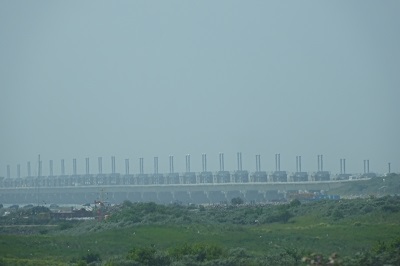 The forecast had predicted great weather for Saturday, so that had been planned as a full nice lovely beach day, but of course the morning greeted us with grey bleak skies. At a loss for what to do, we finally decided to go and have a gawk at Renesse, another little beach town further north on the island of Schouwen-Duiveland. Which was worth it alone for driving across the monumental four-kilometre-long storm barrier across the Oosterschelde, the Eastern arm of the Schelde estuary.
After the disastrous floods of 1953, that drowned most of Zealand and killed more than 1,800 people, the Dutch decided they had had enough of the vagaries of the North Sea and created the Delta Works, one of the most ambitious engineering projects in the history of mankind (which you can read more about here if you want) and frankly, it was rather impressive to see.
Renesse I had always heard about as some sort of mythical Dutch Ballermann, a party place where the youth from our area would congregate in the summer months to drown what little brain they had in beer. What we found was a perfectly charming little town with shops, cafes and restaurants very much like Domburg. So after half an hour's walk around, we returned there to spend a final afternoon at the beach, finding it rather windy and unpleasant compared to previous days.
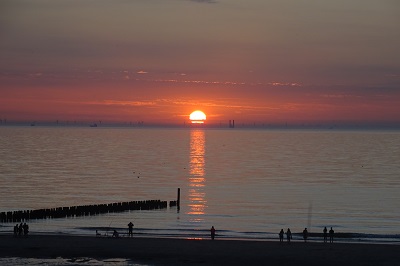
So all in all I was very much reminded why I prefer the Mediterranean and its guaranteed sunshine and warmth for a proper summer holiday, but as a lovely few days out in this mad year in particular, it was a very good choice indeed and I was glad I was able to make my peace with Domburg in particular, putting to rest the demons of that horrid camping trip many years ago. I might even go back to the area some time for a weekend out or something (after all, it's only around 2.5 hrs driving from home), but I am also glad that there's another trip to the Mediterranean booked by now... Corona mayhem willing.
Copyright © All Rights Reserved